
Centinela: The delicate balance between economics and stability in large-scale mining
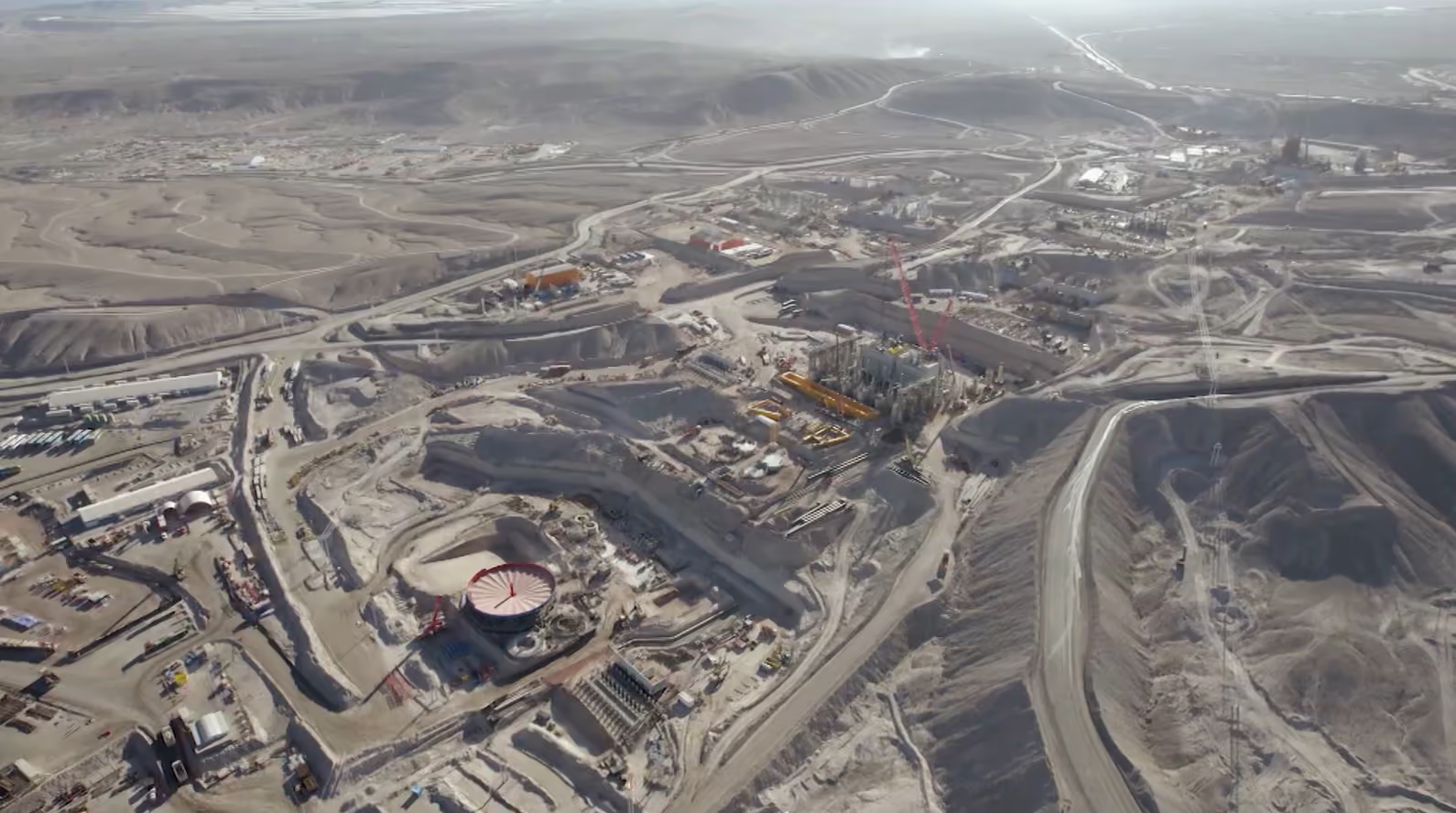
In the heart of the Atacama Desert, one of the most significant mining investments in Chile over the last five years is taking shape: the Nueva Centinela Project by Antofagasta Minerals. This colossal expansion aims to double the site's copper processing capacity and extend its operational life by at least 30 more years.
The figures behind this expansion are staggering. With construction progress nearing 25%, the project expects to reach its peak of activity between 2025 and 2026, involving nearly 13,000 workers. The scale of the work is divided into six major infrastructure packages, including the development of two new mines, a massive concentrator plant, over 2,000 kilometers of electrical cabling, a water pumping system, 145 kilometers of connection to the port, and a new tailings dam with a capacity of 2.1 billion tons.
The open-pit challenge: Vertical or safe walls?
Open-pit extraction presents a constant dilemma for mining engineering. Economically, the ideal approach is to design walls (slopes) that are as vertical or steep as possible, as this reduces the amount of waste material that must be removed to reach the ore. However, geotechnics imposes a vital constraint: the walls must be stable and safe.
Finding that perfect balance is exactly where geotechnical monitoringcomes into play. As Igor Bravo explains during the interview, to protect both people and operations, Geosinergia deploys an arsenal of technological instruments designed to "listen" to and observe the mine's behavior:
- Crackmeters: These measure the opening and settlement of surface cracks (even in 3D). By identifying their orientation and movement, they allow teams to determine whether a crack is stable or unstable, triggering early warnings to protect personnel.
- Piezometers: Water accelerates ground instability. For this reason, "inside" piezometers are used to measure pore pressure, or "Casagrande" type models (open tubes) are used to measure water levels manually or via in-line sensors.
- Wireless Extensometers and TDRs: These are used at depth to detect major faults or internal slides that, if they were to occur, could destroy key ramps.
- Radars: They function as a large "geotechnical map" that assesses the overall stability of walls hundreds of meters high by measuring deformations directly on the surface.
The future: Anticipating failure before it reaches the surface
Although radars are excellent for measuring deformation once the slope is already moving, modern mining seeks to anticipate that moment.
Igor Bravo explains that today's technology allows us to go a step further: seeing the failure before it appears on the surface. When instability begins inside the rock mass, it starts to advance silently until it has enough force to push the outer wall.
To detect this in time, cutting-edge technology is used, such as geophones and fiber optics installed in lateral boreholes. These systems allow for tracking the mountain's microseismic activity and triangulating exactly where the rock began to crack internally.
By identifying this hidden failure, engineers can take preventive measures, such as "unloading" the slope (removing material from the upper or rear area) to stop the slide. Once stabilized, mining operations can continue safely.
The value of Geotechnical Monitoring
Preventing a large-scale slope failure is not just a safety issue; it is critical for the business. If a failure breaks access ramps or causes waste material to collapse onto the extraction zone, the copper ore is diluted with dirt and worthless rock.
In large-scale mining, losing that wealth and having to rebuild operational infrastructure translates into millions of dollars in losses. For this reason, well-executed geotechnical monitoring not only protects lives but is the fundamental pillar that ensures the operational continuity of historic investments like Nueva Centinela.
Watch the next part of the interview to learn more about this topic!👇
If you want to know all the details about this chapter, don't miss the full episode here:




Belo Horizonte, Minas Gerais

