
Chacao Bridge: Structural monitoring and the science of "listening" to vibrations
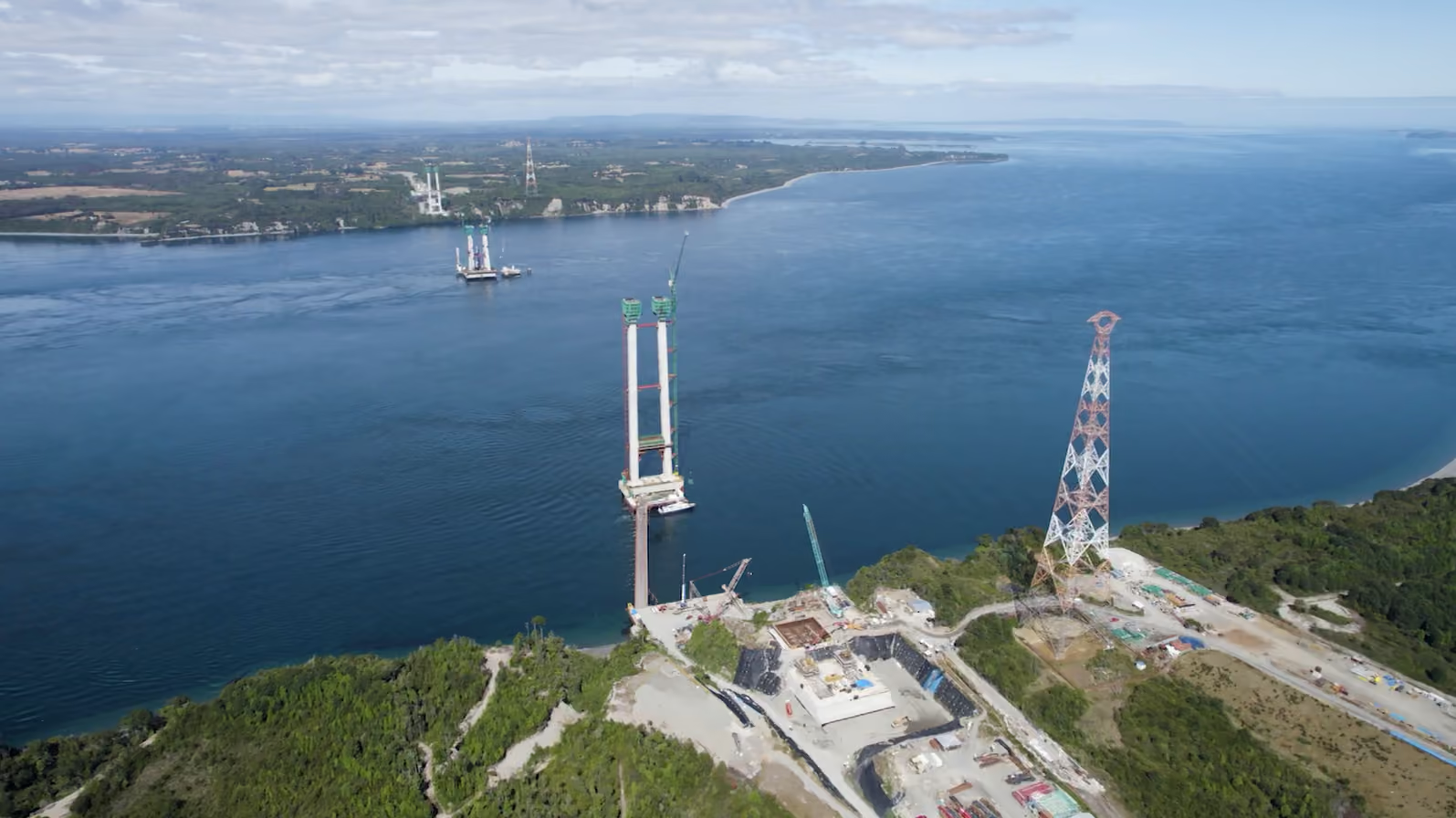
The Chacao Bridge is undoubtedly one of the most ambitious engineering projects in the history of Chile and Latin America. Its mission is historic: to permanently connect the Big Island of Chiloé with the mainland, reducing the current 35-minute ferry trip to a swift 3-minute crossing.
Currently 50% complete and on track to begin operations in the second half of 2028, the bridge faces immense challenges. Spanning over 2.7 kilometers with three main towers—one of which sits atop the Remolino Rock in the middle of the channel—the structure is designed to withstand extreme weather conditions, including winds that can exceed 200 km/h (63 m/s). To ensure safety against these factors, the Ministry of Public Works (MOP) already has various seismographs, accelerometers, and weather stations operational in the area.
However, maintaining this colossal infrastructure requires going a step further. This is where the expertise of Geosinergia makes the difference.
From the ground to the structure: A shift in focus
Unlike work in underground mines or tailings dams, where the focus is on geotechnical monitoring (the behavior of soil and rock), the Chacao Bridge requires structural monitoring.
As Igor Bravo, CEO of Geosinergia, explains in a recent interview, monitoring this suspension bridge is similar to monitoring a giant skyscraper. The primary goal is not just the ground, but the structure itself and, in particular, its foundations: the massive piles that support it.
In the Chacao Channel, the strong currents that flow back and forth represent a constant threat. This water flow can cause a phenomenon known as scouring, which consists of the erosion and removal of the seabed material surrounding and supporting the pile foundations.
The Fourier Transform: Anticipating deformation
To determine if a bridge is suffering from scouring or damage, traditional engineering measures the physical "response"—that is, it assesses whether the structure is tilting or deforming. But Geosinergia uses a much more sophisticated preventive approach: measuring the vibrational mode of the structure.
Every physical structure, no matter how rigid it may seem, has a "heartbeat" or a fundamental vibration period. If the bridge pile foundations begin to be undermined by sea currents, the bridge's stiffness changes, and consequently, that fundamental vibration period is also altered.
To detect this, the team captures multiple vibration data points and applies a complex mathematical formula called the Fast Fourier Transform (FFT). This tool makes it possible to isolate the bridge's exact fundamental period.
Igor Bravo illustrates this with a clear example: suppose that, using the FFT, it is determined that the bridge's normal fundamental period is "4." If this value begins to vary over time, rising to "5" or falling to "3," it is the first warning sign. This change in vibration indicates that something is happening at the base of the infrastructure.
The most fascinating thing about this method is that vibration detects the anomaly long before any visible damage occurs. When the vibrational period changes, it alerts engineers before tilt or deformation sensors can even register a physical response. In this way, structural monitoring acts as the nervous system of the Chacao Bridge, ensuring its integrity and the safety of all the Chileans who will travel across it in the future.
We invite you to watch and learn more about this topic in the next part of the interview!👇
If you want to know all the details about this chapter, don't miss the full episode here:




Belo Horizonte, Minas Gerais

