Deformation monitoring in underground works: from design to risk management
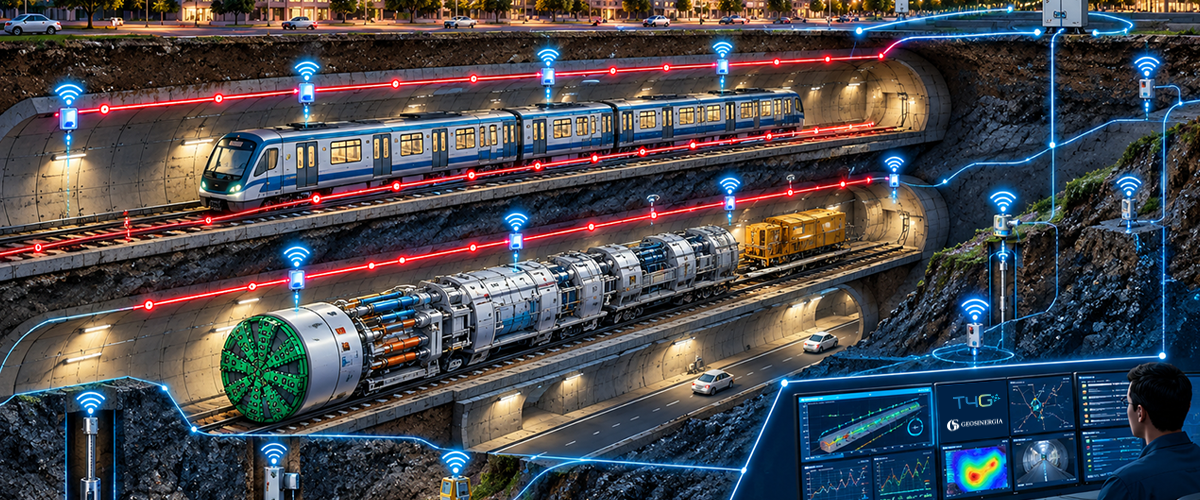
In underground engineering—from urban transport tunnels to deep mining galleries—the initial design represents a hypothesis of how the ground will respond to excavation. However, no matter how sophisticated the numerical models and preliminary geotechnical studies (via boreholes, test pits, and laboratory tests) may be, geotechnics inherently deals with the heterogeneities and uncertainties of the rock mass or soil.
In this scenario, underground deformation monitoring ceases to be a mere quality control requirement and becomes the fundamental pillar that validates design hypotheses and ensures the safety of people and infrastructure.
1. The strategic role of monitoring: Validating or discarding the initial thesis
During the design phase, engineering establishes maximum deformation thresholds and safety factors based on estimated parameters. However, once excavation begins, ground stresses are redistributed and the soil or rock mass reacts in real time.
Continuous structural and geotechnical monitoring allows for:
- Validating actual behavior vs. modeling: Verifying whether observed convergences and deformations remain within the projected envelope.
- Proactive risk management: Detecting early deviations before they exceed critical design thresholds.
- Implementation of control measures: Adjusting the support system (lining, bolts, shotcrete, steel sets) or modifying excavation phases before global stability is compromised.
2. Extreme precision and highly restricted environments
In highly complex urban projects—such as integrating new road tunnels under operational metro lines or high-density residential areas—tolerance margins are on the order of millimeters.
In these environments, design criteria impose extremely restrictive thresholds (of 1 mm to 2 mm of allowable deformation) to prevent:
- Interference with existing infrastructure: Deformation or settlement in adjacent underground structures or neighboring tunnels in service.
- Surface impacts: Tilting or settlement of adjacent buildings, and the appearance of cracks or fissures in pavements and public roads.
To meet this standard of precision, a strategic density of instrumentation is required, combining geotechnical and structural sensors, such as:
- Deep and surface inclinometers: To evaluate horizontal soil deformation profiles and tilting in fixed structures.
- Extensometers and load cells: To monitor the response of structural support and stress in the surrounding mass.
- Crackmeters (crackmeters) and strain gauges (strain gauges): For sub-millimeter micro-structural assessment (measurements in microstrain) on steel or reinforced concrete elements.
3. Technological evolution: Telemetry, IoT, and the real-time T4G platform
Historically, data collection in underground works involved periodic manual inspection inside the tunnel using dataloggers individual, which limited reading frequency and response speed to contingencies.
Today, the convergence of the Internet of Things (IoT) and long-range telemetry networks (such as LoRa technology) along with the T4G integration platform has radically transformed geotechnical monitoring:
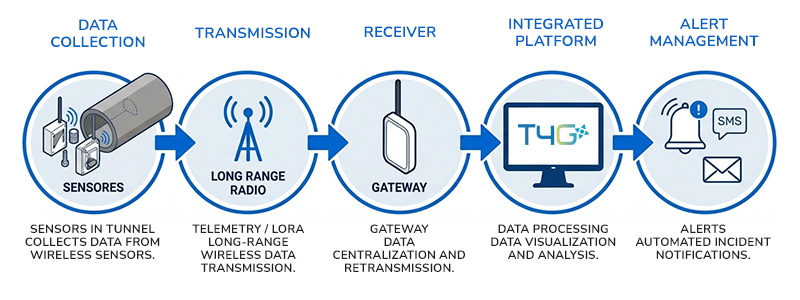
- Constant update frequency: Automated data capture and transmission every 15 to 30 minutes directly to the T4G platform.
- Integration and cross-referencing of variables: Centralization in T4G that allows for cross-referencing readings from different sensor families (for example, relating data from inclinometers with topographic prisms and extensometers) to obtain comprehensive and robust diagnostics.
- 24/7 early warning protocols: Automatic generation of notifications (via email or phone) instantly on the T4G integration platform the moment preventive thresholds are exceeded (alert, caution, alarm), ensuring total control at any time.
4. A cross-sector reach: From mining to Digital Twins (SHM)
Although urban underground works impose a critical level of demand, the principles of geotechnical and structural monitoring are applicable across all engineering sectors:
- Underground and open-pit mining: Stability control for walls, galleries, stopes, and tailings dams.
- Environmental and regulatory monitoring: Compliance with Environmental Qualification Resolutions (RCA) and historical heritage requirements through vibration and crack control.
- Structural Health Monitoring (Structural Health Monitoring - SHM): Applied to major infrastructure (such as large bridges and viaducts) through the development of Digital Twins (Digital Twins), integrating micro-structural deformation data in real time to predict the service life of components.
Interested in learning more about this topic?
To learn more about the practical application of these technologies in high-complexity geotechnical projects in Chile, we invite you to listen to the interview with Enrique Díaz Parragué, Manager of Structural Monitoring for Civil Works at Geosinergia.